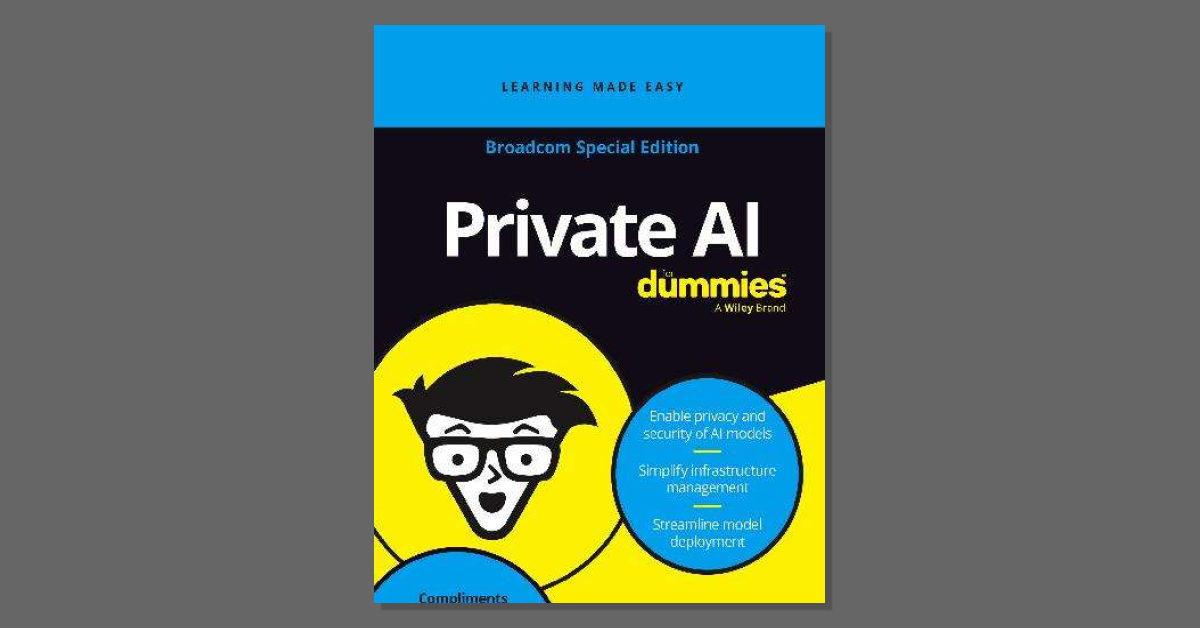
What is “Private AI” and why does it matter for my organization?
In the context of *Private AI For Dummies, Broadcom Special Edition*, “Private AI” refers to building and running AI — especially generative AI (GenAI) — on a fit‑for‑purpose infrastructure that keeps your data under your control instead of sending it to a public cloud service you don’t fully govern.
The book highlights several reasons this matters:
1. **Data privacy and security**
Public cloud–based AI services can raise concerns about who can access your data, where it’s stored, and how it’s used. A private AI approach keeps data within your own controlled environment, reducing exposure to third parties and lowering the risk of data breaches.
2. **Regulatory and compliance requirements**
Many organizations operate under strict regulations (for example, in finance, health care, or government). The book emphasizes that the right AI infrastructure helps you meet regulatory requirements by controlling data location, access, and processing. Private AI is positioned as a way to align GenAI initiatives with privacy, security, and compliance obligations.
3. **Operational control and trust**
Private AI gives enterprises more control over performance, cost, and model management. This control helps build trust with customers and stakeholders because you can clearly explain how data is handled and protected.
4. **Fit‑for‑purpose infrastructure**
The book focuses on designing infrastructure specifically for AI workloads — including considerations around semiconductors, enterprise software, and virtualization. This infrastructure is meant to be safe, flexible, scalable, and automated so organizations can simplify AI operations and optimize resource allocation.
In short, Private AI is about rethinking how you deploy GenAI so you can harness its potential while keeping sensitive data secure, staying compliant, and maintaining operational control.
What challenges do organizations face when adopting generative AI?
The book outlines several practical challenges that organizations run into when they move from experimenting with generative AI to deploying it in production:
1. **Privacy and security concerns**
Using off‑the‑shelf public cloud AI services can create uncertainty about data exposure. The book notes that this is a major issue for organizations that handle sensitive or regulated information and need to ensure data is not shared with third parties.
2. **Compliance and regulatory pressure**
Ensuring that AI workloads comply with industry regulations and internal policies is a recurring theme. The text explicitly calls out the need to “keep your data safe while meeting regulatory requirements,” which becomes harder when data and models are spread across public cloud environments.
3. **Infrastructure complexity and management**
AI, and especially GenAI, demands significant infrastructure management capabilities. Organizations must handle GPU resources, storage, networking, and model lifecycle management. The book dedicates multiple chapters to topics such as:
- Safeguarding privacy and security
- Controlling costs and achieving return on investment
- Choosing large language models (LLMs)
- Achieving required performance
- Ensuring compliance
- Managing AI deployments and monitoring GPUs
4. **Cost control and ROI**
The text highlights “controlling costs and obtaining return on investment” as a core challenge. AI workloads can be resource‑intensive, and without careful planning, spending on compute (especially GPUs) and cloud services can outpace business value.
5. **Choosing and managing models**
Selecting the right large language models and managing their lifecycle is non‑trivial. The book discusses risks in AI model management and the need to balance performance, cost, and compliance.
6. **Balancing innovation with risk**
Organizations want to take advantage of GenAI’s potential for new applications — from content generation to conversational interfaces — but must balance this with privacy, security, and operational efficiency. The book positions Private AI as a way to navigate this balance.
Overall, the challenges are less about the algorithms themselves and more about infrastructure, governance, and risk management around GenAI.
How does VMware Private AI Foundation with NVIDIA help unlock Private AI?
The book presents **VMware Private AI Foundation with NVIDIA** as a key platform for organizations that want to adopt a Private AI approach. It focuses on how this platform helps you design and operate an AI‑ready infrastructure in your own controlled environment.
Key capabilities highlighted include:
1. **Architecture designed for AI workloads**
The platform provides an architecture specifically built for AI, including support for GPU‑accelerated workloads. It leverages a full‑stack, software‑defined infrastructure (through VMware Cloud Foundation, or VCF) to run AI applications efficiently.
2. **Privacy and security of AI models and data**
A core theme is enabling privacy and security. By running AI models on your own infrastructure, you keep data and models within your security perimeter. The book notes that with a private AI approach, “data remains secure and is never exposed to third parties,” which aligns with regulatory and internal governance needs.
3. **Simplified infrastructure management**
The platform is designed to simplify day‑to‑day operations:
- Virtualization of GPUs and other resources
- Resource allocation and sharing across teams
- Support for live migration and cloning of virtual machines
- Monitoring of GPU usage
These capabilities help IT teams manage AI workloads alongside existing enterprise applications.
4. **Streamlined model deployment and optimization**
The book discusses fine‑tuning large language models and optimizing retrieval‑augmented generation (RAG) workflows. VMware Private AI Foundation with NVIDIA is positioned as a way to streamline model deployment, tuning, and lifecycle management on a consistent infrastructure.
5. **Support for diverse AI use cases**
The text lists several example use cases the platform can support:
- GPU‑as‑a‑Service for internal teams
- Agentic AI
- Code generation and creation
- Contact center resolution and experience
- Document search and summarization
- Private, secure content creation
6. **Cost optimization while staying compliant**
The book contrasts public cloud and on‑premises approaches, then focuses on how to optimize cost while maintaining compliance. By virtualizing infrastructure and sharing GPU resources efficiently, organizations can better align AI spending with business value.
In summary, VMware Private AI Foundation with NVIDIA is presented as a way to reimagine AI infrastructure: bringing GenAI capabilities into a secure, compliant, and manageable environment that fits enterprise requirements for privacy, control, and operational efficiency.



 Sign in with LinkedIn